Blog
How Context Mode is built, what changed, and what we measured. Also as an Atom feed.
Context Mode 2.0: what we rebuilt and what we learned
Context Mode 2.0 is a free plugin that runs on your machine in 10 coding agents. What changed from the 1.x line and why, the numbers with their sources, eight lessons, and how to install it with your agent's own command.
One gateway for 7 coding agents: Pi, OpenCode, T3 Code
Context Mode now connects 7 apps: Claude Code, Claude Desktop, Codex, Codex Desktop, T3 Code, OpenCode and Pi. Install each app its makers' way, then run npx @context-mode/cli. One console, one memory store, plain per-app limits.
Claude Desktop with Context Mode: memory, skills, saving
Claude Desktop has a third-party inference mode. Turn it on, run npx @context-mode/cli setup --agent claude-desktop, quit with Cmd+Q, and every request gets Saving, Memory, Skills, Instructions and Recall. What works and how to undo it.
Codex Desktop (ChatGPT app) now runs with Context Mode
Codex Desktop, the Codex inside the ChatGPT app, reads ~/.codex/config.toml. One command writes it once for the app and the CLI, with a backup first and only its own lines changed. What you get and how to undo it.
Pi coding agent with Context Mode: memory, skills, saving
Install Pi its own way, run one command, and every Pi request gets Saving, Memory, Skills, Instructions and Recall. What setup writes in models.json and which logins work.
Connect OpenCode to Context Mode in one command
OpenCode now runs through Context Mode. Install OpenCode its own way, add your Anthropic API key, run npx @context-mode/cli setup --agent opencode. What it changes, what you get, and the limits.
T3 Code now runs through Context Mode
How to connect T3 Code to Context Mode. T3 Code runs the Claude Code and Codex you already have. Install T3 Code its own way, then run npx @context-mode/cli setup --agent t3code: both configs are set once each. What you get and what setup changes.
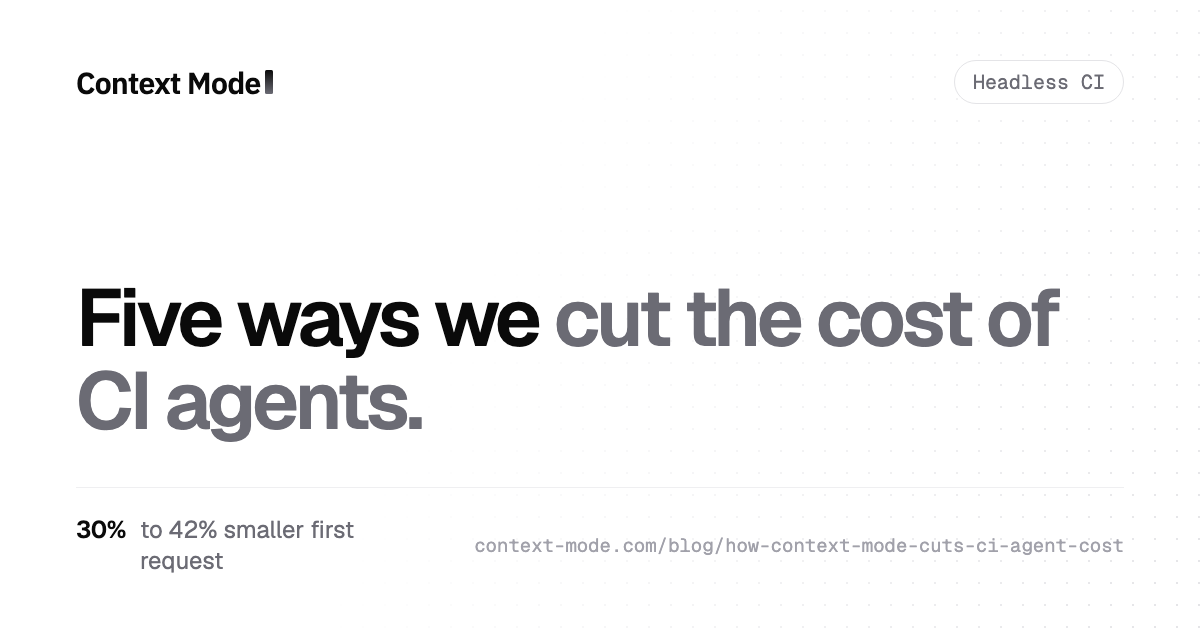
How Context Mode cuts the cost of AI agents in CI
A CI agent repeats the same job and re-sends the same prompt. The five levers that cut that cost, what no proxy can change, and the paired results with their 95% ranges.
Where the money goes in a CI agent run
A direct CI run split by cause, the list prices behind it, and the cache write and read rule that decides whether removing tokens saves money.
What we learned measuring AI agents in CI
How we measure CI agent cost, what went wrong, and the rules we run by now. Each rule links the file that shows it.
tau3-banking: -39% agent cost, measured in the open
The tau3-banking result, how it was run, what is public, and how to rerun the analysis. Side by side with Induction's published numbers.
Headless CI: what we learned about cost per run
A coding agent in CI sends the same long prompt on every pull request. What we measured through the gateway, what we learned about CI cost, how it saves, and the two commands that turn it on, with the proof and a way to repeat it.
Worker exceeded memory limit: 18 days on Cloudflare Workers
Your coding agent showed "API Error" because a Cloudflare Worker isolate ran out of memory. The causes (a 64-character slice that kept 25 MB alive, an unbounded queue, garbage made faster than GC frees it), the move to Rust and Wasm, our mistakes, and a checklist.
One night with Cloudflare's on-demand Workers profiling
Logs could not explain why our busiest Durable Object queued for seconds. Cloudflare's on-demand profiling could. What the profiles showed, what we fixed in one night, the pitfalls, our mistakes, and our wish list.
Wrong skills, noisy memory, false resumes: the fixes behind them
Your agent loaded the wrong skill, got facts it did not need, or replayed yesterday's session after a "hi". We moved those choices to Cloudflare's Clef decision models, measured each move, and shipped three of four.
The right skill on the right turn, or none at all
Skills only help if the right one loads on the right turn and stays out when you are chatting. How Context Mode now makes that choice and what improved (4 of 10 to 10 of 10 on a small sample, p95 from 4,728 ms to 612 ms).
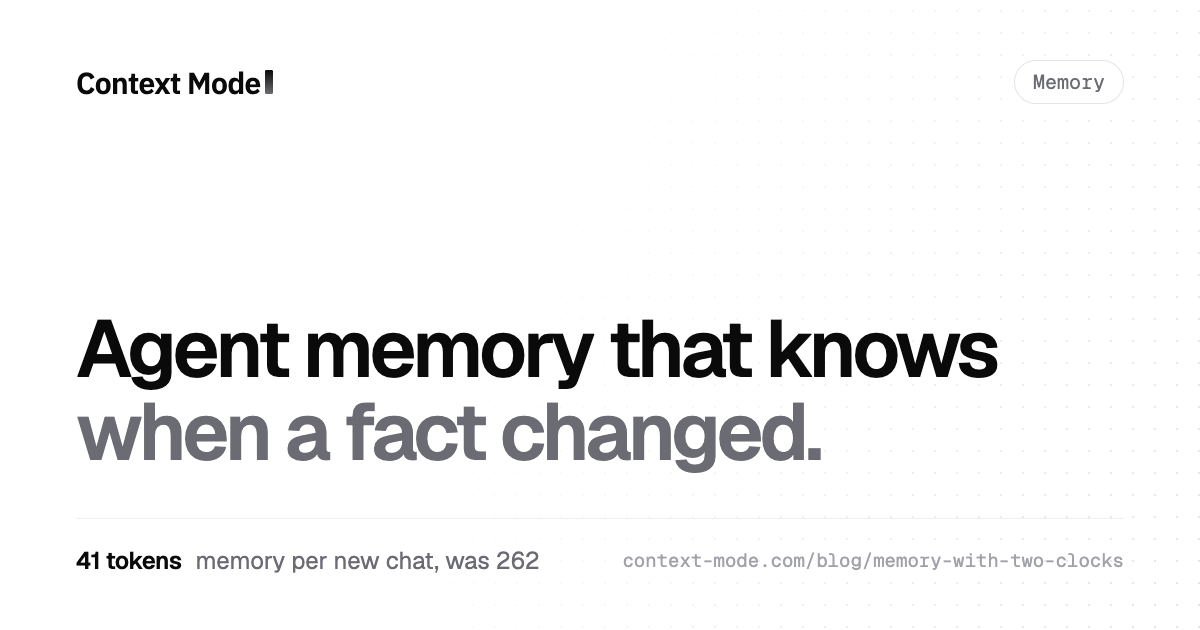
Agent memory that knows when a fact changed
Your agent forgets what you said yesterday, or remembers the old answer. Context Mode memory closes facts that changed, keeps them in the right worktree, and sends back fewer, more relevant facts: 41 tokens instead of 262 in an offline eval.
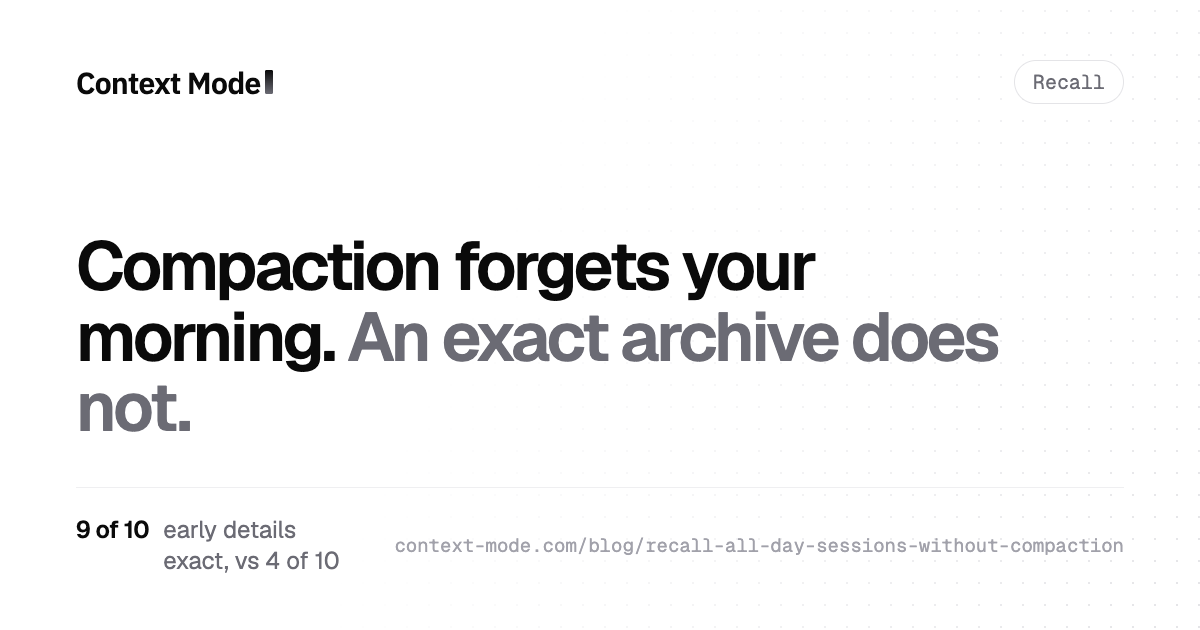
All-day agent sessions without compaction: how Recall works
A long agent session either compacts and forgets your morning, or resends the whole history on every request. Recall keeps every word in an exact archive: in a pre-registered A/B it never compacted and answered 9 of 10 early-detail questions against 4 of 10.
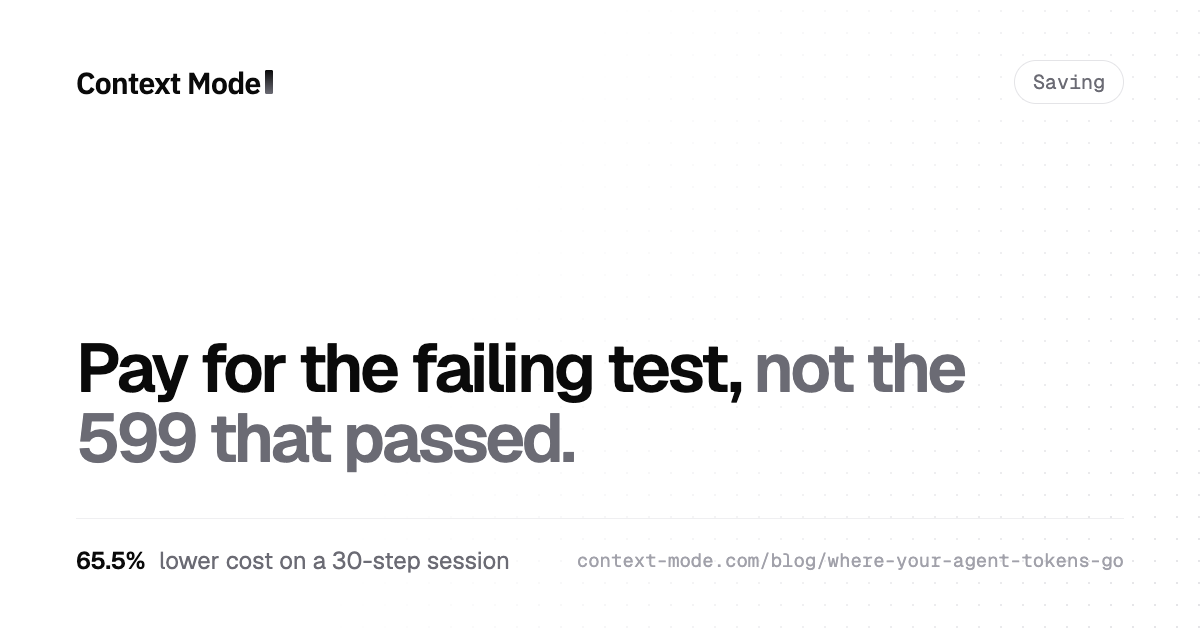
Your agent pays for the same test log on every call
A test log your agent read once is paid for again on every later call. Context Mode folds it on first sight, keeps every byte in your archive, and in paired runs cut a 30-step Opus 5.5 session from $7.20 to $2.49.
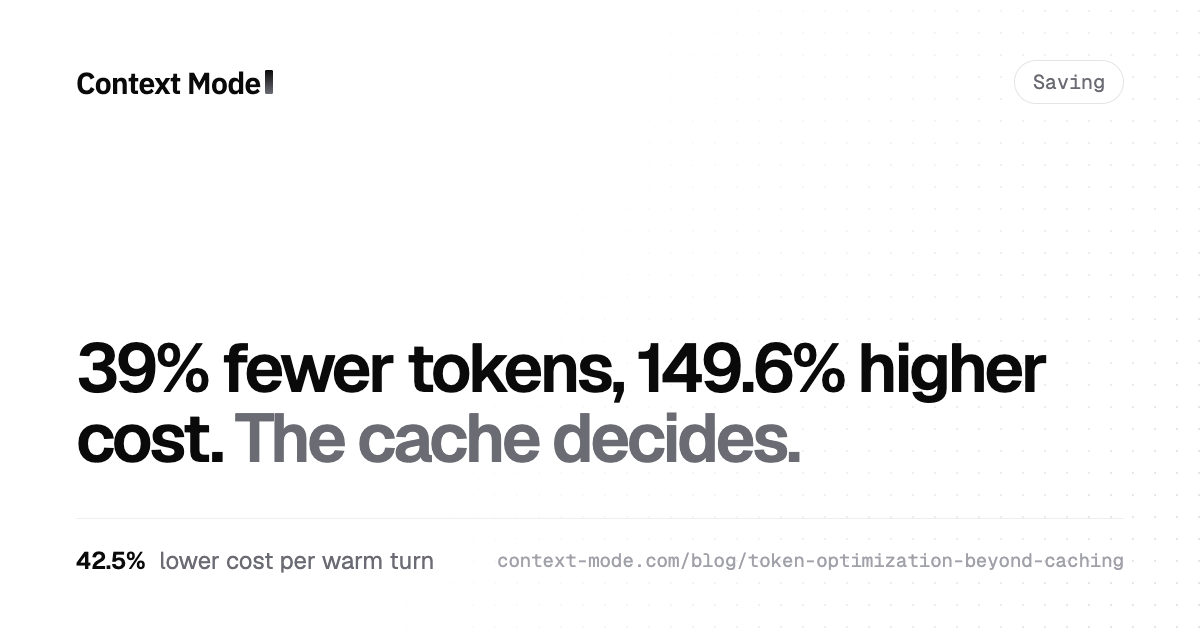
Why 39% fewer tokens cost us 149.6% more, and what we changed
Cutting tokens can raise your agent bill when it breaks the prompt cache. Here is how Context Mode trims tool schemas, holds the cached prefix still, and counts price tiers and Codex cost, with the numbers.
Rules your coding agent cannot rename its way around
Guarding a coding agent by tool name misses argv shells, hidden substitutions and new agents' tools. Protect now reads a shell by the shape of its input, and an API key can no longer loosen your rules: 126 of 126 production checks pass.
How we prove Context Mode does not break your coding agent
Anything between your agent and the model must not break a turn or turn off a feature you pay for. Here is how we test Context Mode with both real clients, every account state, and every new model.
What happens when your plan runs out: your agent keeps working
A quota should never break your agent in the middle of a task. When Context Mode pauses, your agent runs as plain Claude Code or Codex, with a heads-up first and a one-click way back.
Durable Objects in production: 14 lessons from Slipstream
Measured lessons from rebuilding our request path on Cloudflare Workers and Durable Objects: placement, location hints, wake time and script size, the six-call limit, an RPC trap that cost us 2.5 hours, and partial indexes.
Slipstream: a shorter path from your agent to the model
The memory stores moved to their own Worker, a request makes at most two store calls before the model call, and memory and skills are picked by newer models. What we measured, and what went wrong during the rollout.